How It Is Made
How it is made
Laying a leaf in a bowl and firing it is not enough. The veins only stay when glaze, ash and temperature agree.
Leaf tenmoku is often described as an accident. The beginning may well have been one. But a working kiln today has to reproduce the accident on purpose. Here is the process in six steps.
One — the leaf
Mulberry, mostly. A mature leaf, thicker than a young one, carries more ash and leaves heavier veins. Picked leaves are dried in shade until the water is out, then trimmed to shape. Damage the leaf at this stage and the vein will break in the firing.
Leaves are taken in summer and autumn. Young leaves carry less ash and leave only a faint pattern. Leaves with holes or tears are rejected; what you want is a leaf whose veins run evenly to either side. After picking they are pressed flat to take out the curl. A curled leaf will not sit against the glaze, lifts during firing, and loses part of its pattern.
Two — the body
Jizhou clay is low in iron and fires to a pale grey-white. This is the opposite of Jian ware, whose body is black. The light body is what lets a leaf pattern read at all: it is the paper behind the drawing.
The body is thrown on the wheel or formed in a mould. A standard leaf bowl is a thrown round form. After throwing, the foot is turned and the bowl dried. Cut the resting surface too flat and shrinkage in the kiln leaves it rocking. The diameter of the foot and the angle where it rises decide how steadily the finished bowl sits.
Three — black glaze
An iron-rich black glaze goes on inside and out. It is not applied evenly on purpose. The difference between thick and thin is what later becomes the glaze break at the rim — the red-gold weather of the bowl.
Glaze goes on by dipping or pouring. The rim thins naturally, and that is where the red-brown appears after firing. Too thick, and the glaze runs down to the foot in the kiln and fuses the bowl to the shelf. Potters judge thickness by fingertip and by the sheen of the wet surface — by experience, not by gauge.
Four — the leaf goes on
The prepared leaf is laid on the wet glaze, tip toward the centre of the bowl as a rule. Then a pale, ash-rich glaze is poured over it. This upper glaze is the partner the leaf ash will react with.
A dry leaf is brittle and will not take to the glaze as it is. It is dipped briefly in water, softened, and its creases smoothed before laying. Once in place it is pressed down lightly so that no air remains; air left underneath lifts that part of the leaf and leaves a hole in the pattern. The tip is aimed from the centre of the bowl.
Five — the firing
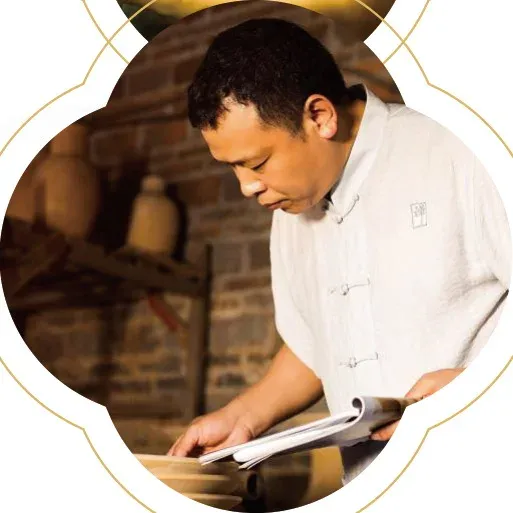
About 1,300°C. On the way up, the leaf chars, then burns to ash. The ash dissolves into the glaze and, as the kiln cools, sets in the shape of the veins. Shift the temperature curve and the ash runs; the pattern disappears.
The kiln is fired in reduction: with the oxygen restricted, iron in the glaze reduces and the black deepens. Cooling after the peak matters as much as the climb. Cool too fast and the ash never fixes; too slow and it runs. This is why the potter logs temperature and resets the conditions with every firing.
Six — opening the kiln
Not everything survives. Bowls where the leaf ran, where the leaf puckered too hard, where the glaze shrank back, are set aside. The proportion of bowls that come out with one leaf cleanly fixed is never high.
Selection looks at three things: whether the veins run unbroken, whether the outline has sunk too far into the glaze, and whether the crazing has opened unnaturally. Even within one kiln, the top shelf and the bottom differ by several degrees. That difference decides which bowls keep their leaf.
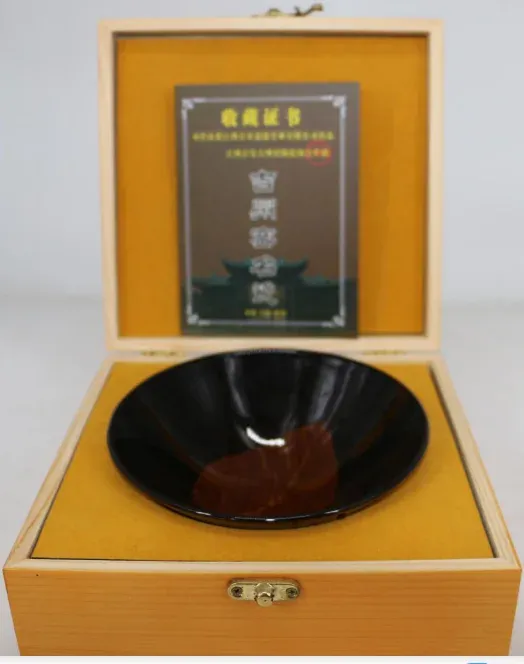
YIELD — Every firing is also a selection
Potters say a kiln either lives or dies: ichi yō sei, ichi yō shi. Even within one firing, temperature and ash flow differ from shelf to shelf, and the bowls divide into those that keep their leaf and those that do not. What we sell has passed that selection.
Questions
Is the leaf real?
Yes. Mulberry is usual; bodhi and maple are also used. The leaf burns away entirely, and only its ash remains, fused into the glaze.
Can I make one myself?
Three things have to agree: glaze composition, leaf preparation, and the kiln's temperature curve. Without them the ash runs and no pattern forms.
Why can no two be identical?
Because one leaf's shape and ash distribution transfer directly to the bowl. Leaves from the same tree still run their veins differently.