
How to Tell
How to tell
The difference in price usually shows up in three places. Where the leaf sits, where the glaze breaks, how the foot is cut. In that order.
A single photograph is enough to tell a great deal — if you decide in advance where to look. These three points are where a one-off bowl and a production piece separate most clearly.
One — where the leaf sits
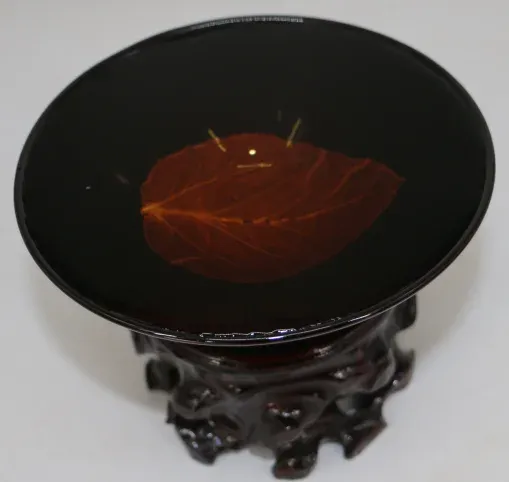
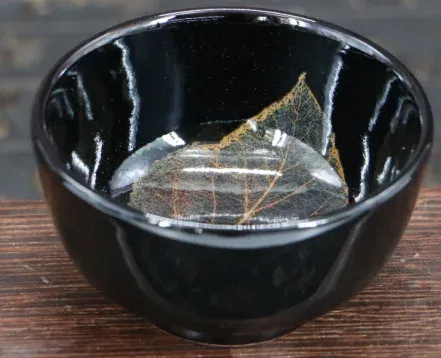
In a one-off bowl the tip of the leaf points toward the centre of the bowl. A leaf pushed to one side, or stuck against the rim, is evidence that its position was not decided when it was laid.
Production pieces may be pressed from a mould or decorated by transfer. In that case the veins are unnaturally even, and the edge of the leaf is smooth rather than serrated.
Two — where the glaze breaks
Toward the rim the glaze thins and its iron oxidises, firing red-brown to gold. Potters call this the glaze break. In a one-off bowl it falls differently on every piece.
Production pieces control glaze thickness mechanically, so the break is identical every time. Put several photographs side by side: if the rim looks exactly the same on all of them, the bowls came from a mould.
Three — how the foot ring is cut
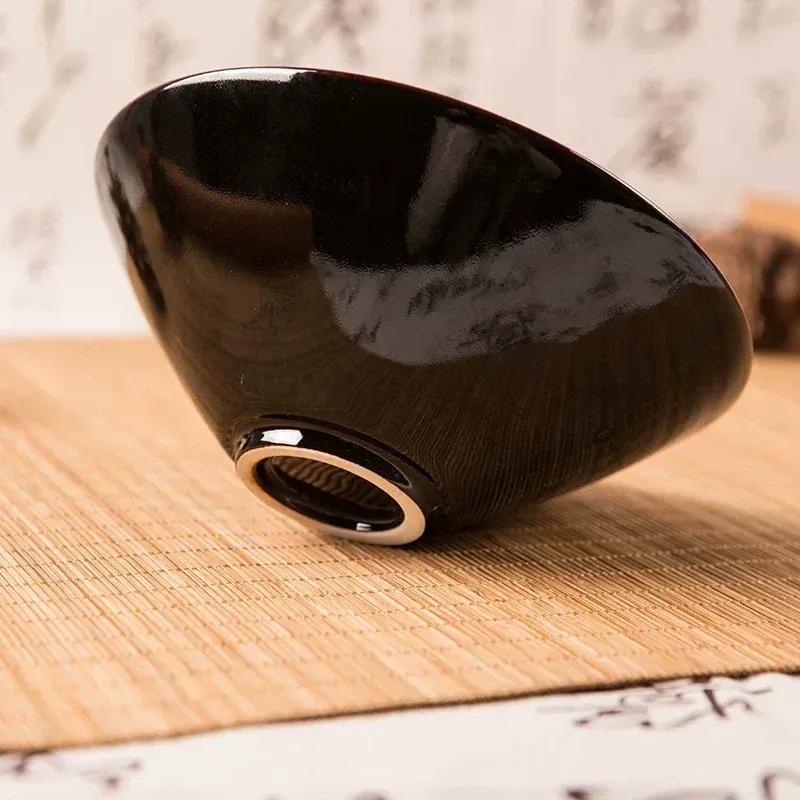
Turn the bowl over. On a one-off, the resting surface of the foot is chamfered with care and the tool marks remain inside. Fine, regular lines from the wheel are what you want to see.
On a production piece the inside of the foot is often rough, or the resting surface is perfectly flat. This is the part photographers tend to leave out, which is why a shop that never shows the underside is worth avoiding.
| Look at | One-off | Production |
|---|---|---|
| Position of the leaf | Tip toward the centre; differs every time | Identical placement; veins too even |
| Glaze break | Different red at the rim on every bowl | The same on all, or mechanically even |
| Foot ring | Chamfered, with fine tool marks | Rough, or too flat |
Old ware and new
Song and Yuan bowls usually show fine crazing across the glaze, and wear on the resting surface of the foot. New bowls craze less and their glaze is more uniform. Judging age from a photograph is unreliable, though: you need provenance, and the inscription on the box. We sell new work only.
Questions
Can you tell a one-off from a photograph?
Leaf position and the glaze break can be read from a photograph. The foot needs a photograph of the underside. If there is none, ask the seller for one.
Is a partly missing leaf a fault?
Ash can run during firing and leave the leaf edge looking eaten away. It is a result of the kiln, not a defect. Whether you like it is a matter of taste.
Do production bowls also have leaf patterns?
Yes. Moulded and transfer-printed versions circulate. Their veins are unnaturally even and the leaf edge is smoothed over.