Taiha Tenmoku
Taiha tenmoku
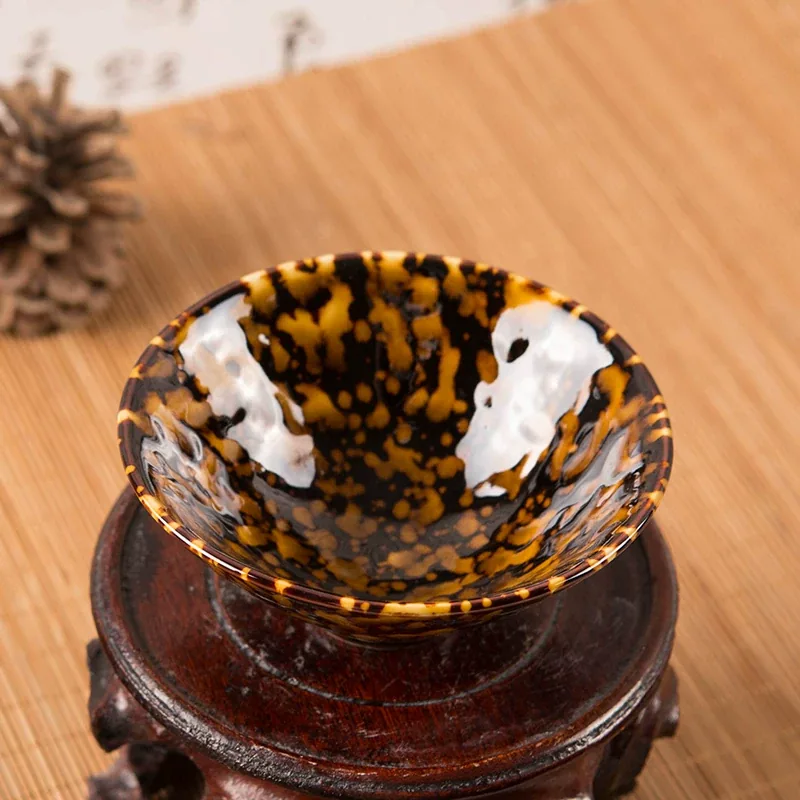
Also called bekkyō — the turtle-shell bowl. Yellow-brown mottling runs across black glaze. It is the only Jizhou ware to hold National Treasure status.
The mottling comes from ash
Taiha tenmoku begins with an iron-rich black glaze. Rice straw is burned to ash and dusted over the wet surface before firing. The ash melts into the glaze and opens as yellow-brown spots, so that black and ochre run together in patches. The result resembles the shell of a turtle, which is where the names come from — taiha, tortoiseshell, and bekkyō, turtle-shell bowl.
The mottling comes from glaze that flows, pools and shrinks. Where a bowl sits in the kiln and how hot it gets decide both the density of the patches and their colour. Some come out bright, like scattered gold; others settle to a brown close to the colour of flame. No two firings match, even from the same kiln on the same day.
It is the other great Jizhou technique, and it works in the opposite direction to leaf tenmoku. The leaf bowl is about keeping a shape. The taiha bowl is about scattering ash. One kiln, two contrary results.
The National Treasure
The bowl at Shōkoku-ji in Kyoto was designated a National Treasure on 31 March 1953. Inside, fifteen peony roundels cut from paper sit under the glaze; outside, tortoiseshell mottling circles the wall. It was treasured by Matsudaira Fumai, passed through the Unshū Matsudaira family and the Manno Museum, and came to the temple.
It measures about 11.7 cm across and 6.3 cm high — a size smaller than a standard leaf bowl, and deeper in the body. It still travels to exhibitions.
The other four tenmoku that hold National Treasure status are listed under National Treasures.
The designation date and collection follow the Database of National Cultural Properties.
Fourth place, in the Muromachi ranking
Kundai Kan Sōchōki divided imported Chinese wares into four grades: yōhen at ten thousand hiki, yuteki at five thousand, Jian bowls at three thousand, and bekkyō at one thousand. Taiha tenmoku was fourth.
Four hundred years later, the fourth became a National Treasure. Rank was never fixed. That is the interesting part of this bowl.
NOTE — Four names for one thing
Taiha, taihi, tortoiseshell tenmoku, and in older texts bekkyō. We use taiha tenmoku throughout, because it is the name most often printed in Japan.
Availability
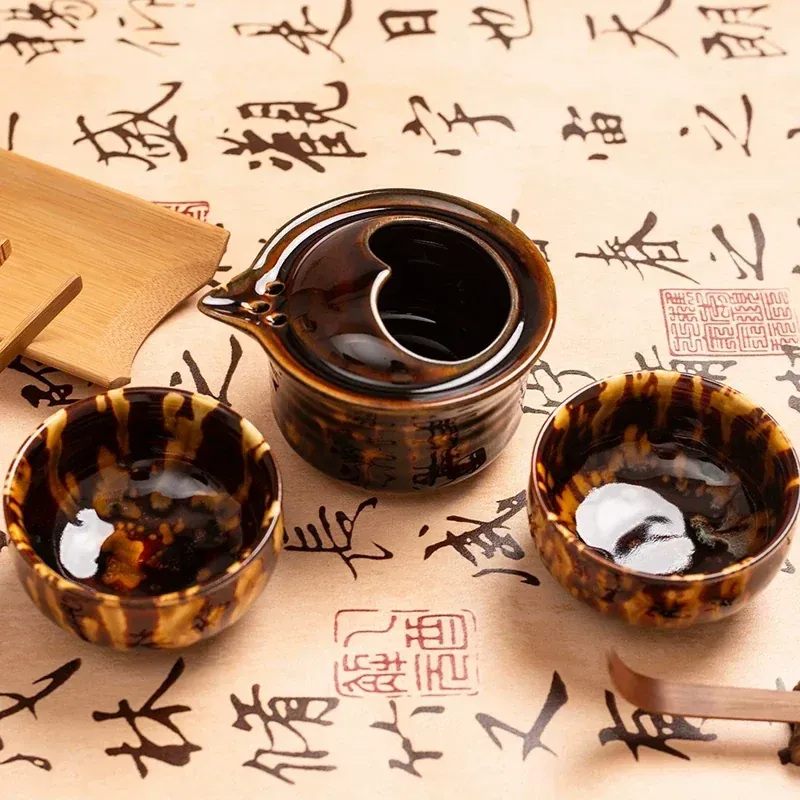
Deep round bowls that work as matcha bowls. Alongside the tortoiseshell bowls we carry a cut-paper dish and a cut-paper tea set.
Questions
Are taiha and tortoiseshell tenmoku the same thing?
They are names for the same ware. Taihi and, in older texts, bekkyō are also used. We use taiha tenmoku throughout.
Can the National Treasure taiha bowl be seen?
It belongs to Shōkoku-ji in Kyoto and can be seen when the temple's Jōtenkaku Museum displays it. It is not on permanent view. Designation details are under National Treasures.
Is taiha ranked above or below leaf tenmoku?
Neither. Taiha appears fourth in the Muromachi ranking and leaf does not appear at all. That ranking graded imported wares, not the quality of a bowl.
Can it be used for matcha?
Yes. The bowl is deep enough for the whisk to work. Avoid sudden changes of temperature; washing is covered under care.