Tenmoku-dai
Tenmoku-dai
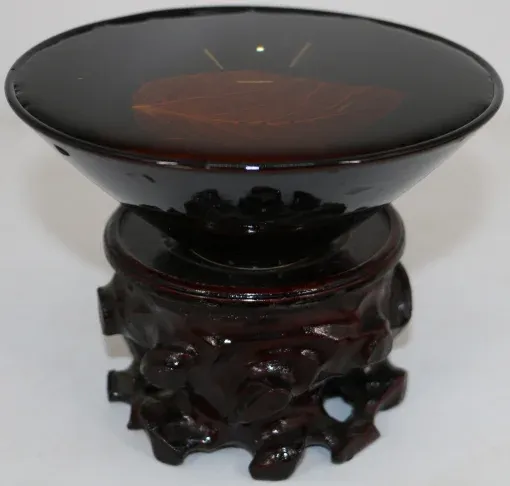
The stand a bowl rests on. It survives from the era when a tenmoku bowl was handled as a Chinese import, and it carries more formality than the bowl itself.
Why a stand at all
A tenmoku bowl has a wide mouth and a small foot. Set down directly on the mat it is unstable, and the rim is easily chipped. So it came to be handled on a lacquered stand. In the shōin arrangement of the Muromachi period, bowl and stand were treated together as one imported object.
The stand is still used in the shōin and daisu tea procedures. Handling a bowl on a stand comes from the etiquette of the warrior household rather than from the tea room.
Types
| Type | Character | Use |
|---|---|---|
| Chinese stand | Made in China; lacquered, with legs | Shōin and daisu procedures |
| Japanese stand | Made in Japan; designs vary | The same, and for practice |
| Flat stand | Low and flat, without legs | Informal settings |
Handling
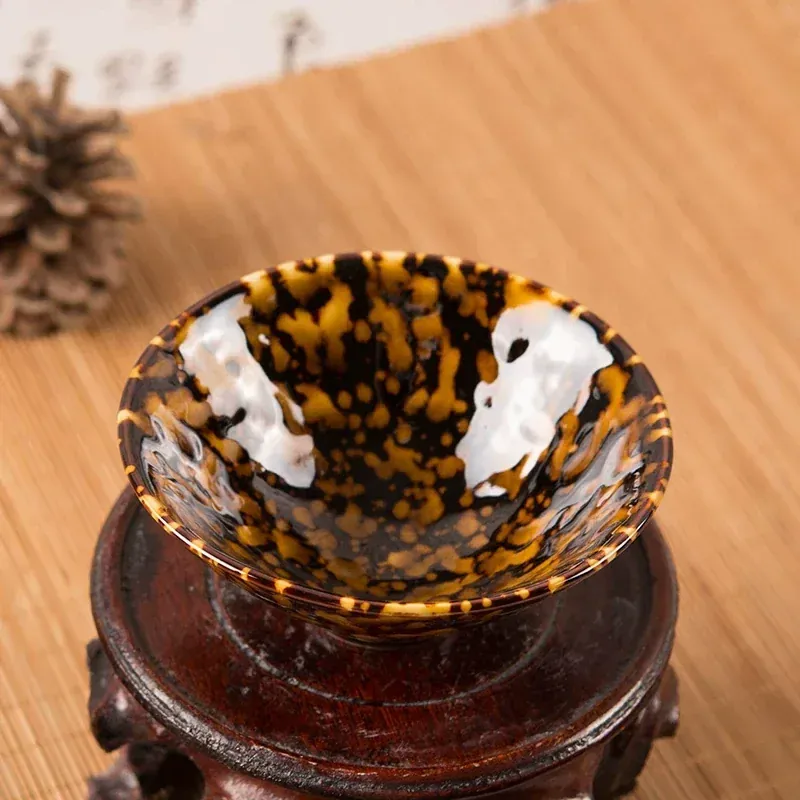
Lift the stand and bowl together, with both hands. Taking the bowl off the stand is done only when the procedure requires it. The legs are thin, and dragging the stand across the mat damages them first.
Some schools lay a cloth between bowl and stand, so that glaze and lacquer do not touch continuously. The same applies in storage. The cloth is folded to the recess and kept from showing at the edge.
Three places to look when choosing one
- The recess — does the foot fit? Too small and the bowl will not sit; too large and it tips.
- The height of the legs — taller stands carry more formality and less stability.
- The lacquer — wear, cracks, joins. On an old stand, repairs are normal.
NOTE — We do not sell tenmoku-dai
We do not stock stands. If you mean to use a leaf bowl in tea practice, whether it fits the stand you already own is decided by the diameter of the bowl and the size of its foot. Measured figures are on each listing.
Will a bowl fit?
The inside of a stand has a recess that takes the foot of the bowl. A bowl of about twelve centimetres across will sit on most stands. Beyond fourteen centimetres, it may not.
Our leaf bowls carry measured diameter and foot-ring diameter on each listing. Measure the recess of your stand and compare the numbers. A photograph will not show this difference.
How to measure
Three numbers on the stand: the inner diameter of the recess, its depth, and the height of the legs. Two on the bowl: the outer diameter of the foot ring and its height. A recess three to five millimetres wider than the foot lets the bowl settle without rocking.
Too shallow a recess and the foot bottoms out, lifting the bowl. Too deep and the rim touches the stand. If you have both pieces at hand, slide a sheet of paper between them and see where it catches — faster than any measurement.
Questions
Is a tenmoku-dai always necessary?
No. In informal settings the bowl is set directly on the mat. The stand belongs to the shōin and daisu procedures.
What is the difference between a Chinese stand and a Japanese one?
A Chinese stand is a lacquered piece with legs. A Japanese stand is made in Japan, and its design changes with period and school. Neither is ranked above the other.
What should I do when the lacquer wears through?
It is repaired with wiped lacquer. Using it worn will damage the wood underneath, so send it for repair early rather than repainting it yourself.