Five Checks
What a listing says
A photograph is not enough. What the listing states decides how much you can check before you buy.
“Fake” is the word people reach for with tenmoku, but the common case is not forgery. It is a production bowl sold as a one-off. Faking pottery is hard to define legally — unless the origin or the maker is misrepresented, there may be no case to answer. Which leaves the buyer to gather whatever can be read before paying.
How to look at the bowl itself is set out under how to tell. Here the angle is the listing: five things it should state.
Five things to check
One — is there a maker's name?
Not “famous kiln” or “National-Treasure grade”, but a proper noun. A name can be searched and checked. A name you cannot check is the same as no name.
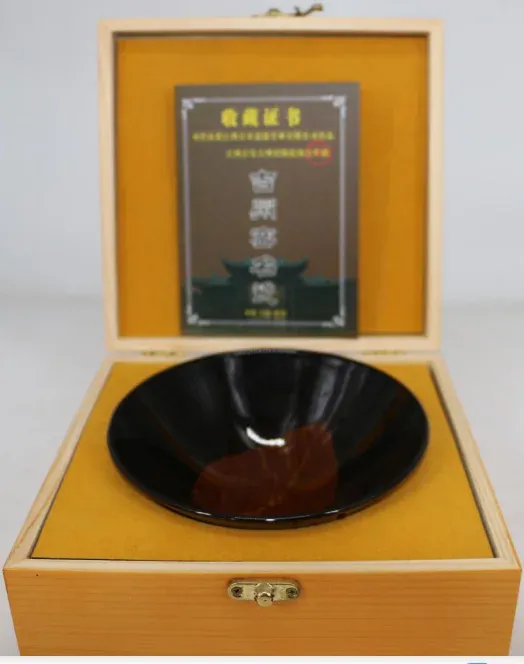
Two — box inscription and seal?
A paulownia box, writing on the lid, a seal on the base. Are all three described? “Wooden box included” does not tell you whether it is a plain box or the maker's own, inscribed.
Three — measured dimensions?
Diameter, foot-ring diameter, weight. Numbers let you check the fit with a tenmoku-dai, or with bowls you already own. The size in a photograph and the size in the hand rarely agree.
Four — where it ships from, and the carriage?
Which country it leaves from, what carriage costs, who pays import duty. For anything crossing a border, these three decide the real price.
Five — the return terms?
What happens if the bowl arrives unlike its description: the window for returning it, and who pays the carriage. There is no reason to pay before that is legible.
WARNING — “National-Treasure grade”, “yōhen recreated”
National Treasure names a designated object; it cannot be used as an adjective. And complete yōhen bowls number three in the world, all in Japan, none for sale. If a listing claims to “recreate” one, at least establish what the claim means.
Where the five things are written
| What to check | Where it appears | If it is missing |
|---|---|---|
| Maker's name | Title, description, box inscription | No work turns up under the name |
| Box and seal | Photographs, description | Only “wooden box included” |
| Measurements | Dimensions, description | Only “palm-sized” and the like |
| Shipping and carriage | Delivery and payment sections | Known only after paying |
| Return terms | Returns section | Known only on asking |
Of the five, only two can be established from photographs. The rest depend on what the text and tables say. Anything unstated can be asked for; the speed and precision of the answer are themselves a way of reading the seller.
A low price is not the problem
Selling a production bowl cheaply, as a production bowl, is healthy. The problem is attaching the words “one of a kind” or “by a named artist” to it. That line is settled by putting the bowl itself against the three checks and the five above.
The bowl-side checks are under how to tell.
Questions
If a listing says “one of a kind”, can I trust it?
A statement alone is not enough. Check whether the same photograph appears on other listings, whether the underside is shown, and whether measurements are given. On a genuine one-off, the same photograph does not come round twice.
Does a box inscription prove the maker?
A box can be supplied later. Check that the inscription, the seal on the base and the maker's name agree. If a certificate comes with it, compare its dimensions and photograph with the bowl.
Should I avoid a listing without measurements?
Not necessarily, but you lose one way of checking. Without the foot-ring diameter in particular, you cannot tell whether the bowl will sit on a tenmoku-dai you already own.